
SMZ1500 Fluorescence Image Gallery
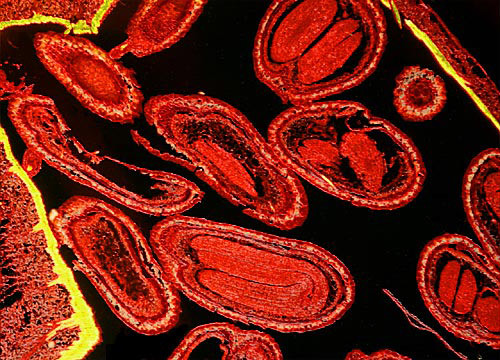
Shepherd's Purse Mature Embryos
The cross-section presented above is an embryo of shepherd's purse (Capsella bursa-pastoris), an annual herb of the mustard family (Cruciferae). A native to Mediterranean regions, this hardy botanical accompanied Europeans in their migrations, and it is now found in most every part of the world.
The shepherd's purse has a slender stem, clusters of tiny white flowers, and triangular seed pods (the seed pods have been said to resemble old-world leather purses). The herb bears flat, heart-shaped fruit pods, which, upon ripening, separate into two valves containing numerous yellow, oblong seeds. Additionally, it has a long history of medicinal applications and is believed to have diuretic and haemostyptic properties. A decoction yields a tannate and alkaloid called Bursine.
Study of the shepherd's purse is favored by scientific investigators of angiosperm embryogenesis because it exhibits a high degree of specificity during embryonic development. In the early stages, the zygote divides into two cells and proceeds through a series of divisions delineating zones which form the principal organs and then the tissue layers. Upon maturation, the ovary develops into the fruit and the ovule becomes the seed.