
SMZ1500 Fluorescence Image Gallery

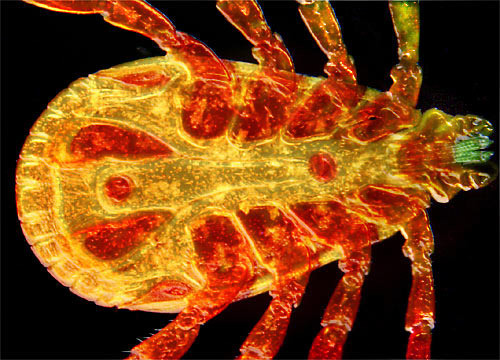
Brown Dog Tick

The brown dog tick (Rhipicephalus sanguineus) is a common blood-sucking parasite found in tropical and subtropical climate regions of the Earth. Although this insect most commonly affects dogs or other canine species, it has also been known to live and feed upon cats, horses, cattle, and, in rare instances, on humans.

Adult female ticks can measure up to 12 millimeters, whereas males are typically much smaller, and grow to a length of only about 4 millimeters. Both genders possess flat, teardrop-shaped bodies having a reddish-brown exterior, and may appear bluish-gray when the insect is engorged.

The brown dog tick has a three-host life cycle. When the larva hatches from its egg, it immediately seeks out the first host animal in the cycle to feed upon. After establishing itself on a host, the larva feeds until it is engorged (filled with blood), which usually requires 2 to 7 days. Once engorged, the larva abandons its host and begins to molt. Molting can take anywhere from 5 to 23 days, after which time the larva is referred to as a nymph. The nymph form again seeks out a host and repeats the process: it feeds, leaves the host, and molts a second time. From the second molting, the tick emerges as an adult and proceeds to seek out a host for the third time. An adult female, once engorged, leaves the host to lay her eggs, after which she will die. Typically, each female lays between 1,000 and 3,000 eggs. The eggs incubate for 19 to 60 days, depending on the season, and hatch to begin the life cycle once again.

Heavy infestation of R. sanguineus can directly produce skin irritations, anemia, and lethargy in the host animal. In some regions, the tick is known to also transmit diseases such as canine babesiosis. Unfortunately, ridding an animal of a brown dog tick infestation can be a difficult task. Extermination of ticks located on the host animal generally provides little respite because, due to the ticks' need to travel to and from a host animal, other ticks are likely to be found in the vicinity and may reinfest the animal. Additionally, though tickicides may temporarily protect the host animal from reinfestation, the effects of these chemicals will certainly wear off before ticks in the area are exterminated (adult ticks can live without a host for up to 19 months).

BACK TO THE SMZ1500 FLUORESCENCE IMAGE GALLERY